
Pool Route Density: The Growth Metric Most Pool Service Businesses Ignore
A pool business can have a full schedule and still lose too much time between jobs.
One customer is ten minutes north. The next is twenty minutes south. Another is across town. Each booking generates revenue, but the driving between those bookings does not.
This is why the number of customers on your books is not the only measure of growth. You also need to consider pool service route density—how closely your customers are grouped together.
A denser route can mean less driving, lower operating costs, more predictable days and room to service more pools without adding another vehicle.
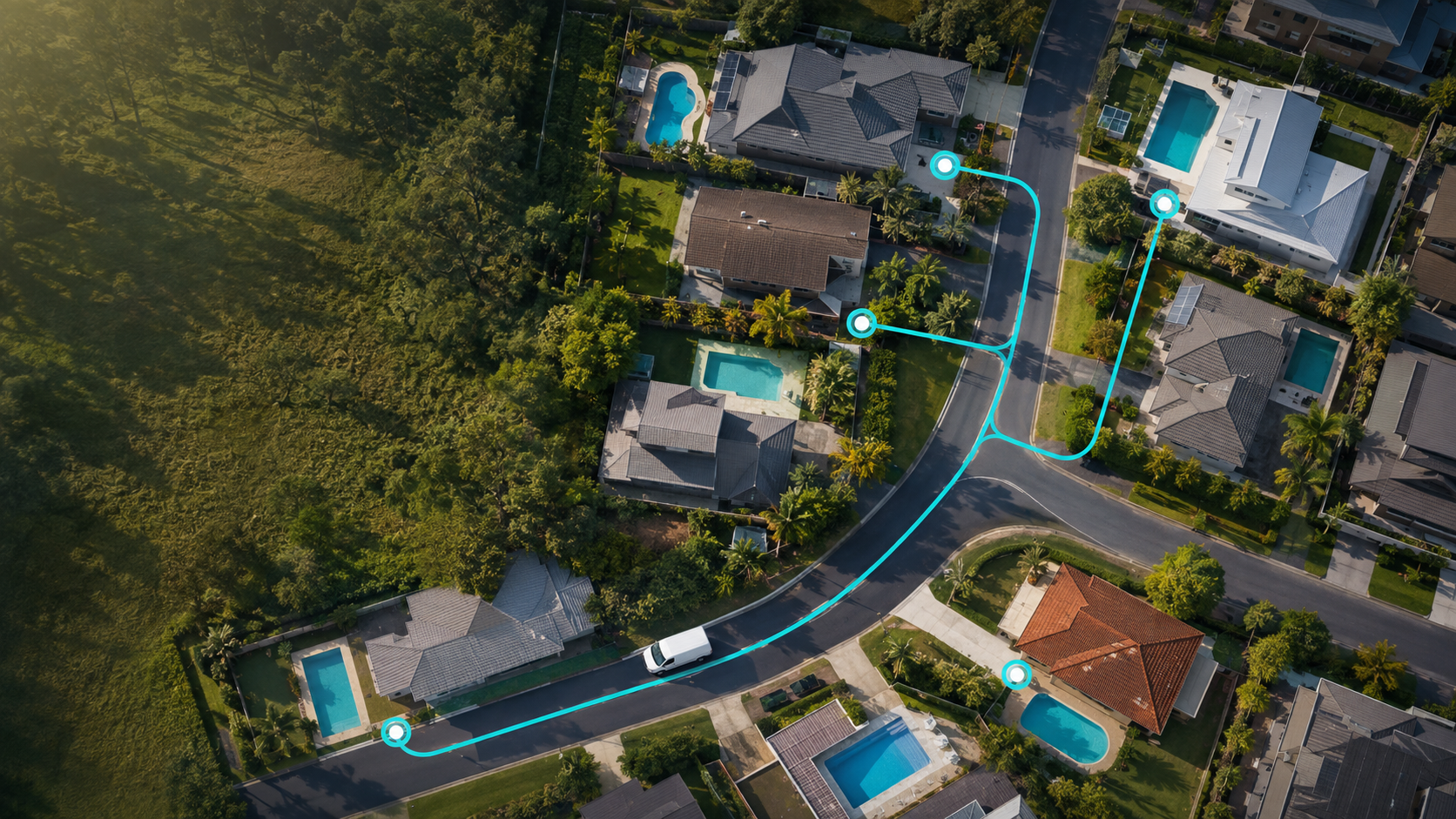
What is pool service route density?
Route density describes how many customers you service within a defined area.
A low-density route has customers scattered across several suburbs. A high-density route has multiple customers on the same street, within the same neighbourhood or along a logical daily path.
Consider two businesses that each service 12 pools per day:
- Business A drives an average of 14 minutes between appointments.
- Business B drives an average of four minutes between appointments.
They may charge the same service fees, but Business B spends considerably less of the day in traffic.
If there are 11 trips between 12 appointments, reducing the average drive by ten minutes saves approximately 110 minutes in a day. That is almost two hours that could be used for additional work, equipment repairs, customer communication or an earlier finish.
This is only an illustration, but it shows why small travel gaps become expensive when repeated across an entire week.
How route density affects profitability
Building a denser route can improve several parts of the business at the same time.
Less unpaid travel
The drive between customers uses staff time, fuel and vehicle capacity without directly generating income.
More services per day
Reducing travel time may allow you to add another appointment without extending the working day.
Lower vehicle costs
Fewer unnecessary kilometres can reduce fuel use and limit some of the wear placed on service vehicles.
Easier scheduling
Customers located close together are easier to move between days when weather, staff availability or urgent repairs disrupt the schedule.
Better local visibility
When your vehicle regularly appears in the same neighbourhood, nearby pool owners become more familiar with your business.
More useful referrals
A referral from a customer on an established route is especially valuable because their neighbours are likely to live within the same service area.
How to build a denser pool-service route
You do not need to replace your entire customer list. Start by strengthening the routes you already have.
1. Map your current customers
Place every regular customer on a map and group them by service day.
Look for:
- Streets containing more than one customer
- Small clusters within the same suburb
- Large gaps between appointments
- Individual customers located far from the main route
- Areas where you already have a strong reputation
This provides a clear picture of where growth will help most.
2. Choose an anchor customer
Select an existing customer in an area where you want more work. This might be:
- A profitable weekly maintenance customer
- A customer located close to your home or workshop
- An outlying customer you want to build a cluster around
- A neighbourhood with suitable access and manageable travel
- A suburb where you already receive referrals
The anchor address becomes the starting location for your search.
3. Identify nearby pool-owning properties
Pool Scout analyses the streets around a location you provide and identifies addresses where pools have been detected.
Open-source internet information is matched with street data, and a person spot-checks the results before the report is sent. You receive a PDF address list and map overlay that can be used to plan a focused local campaign.
See the complete Pool Scout process.
4. Market to a manageable area
Do not try to win every property at once. Begin with a small group of nearby streets and use a clear local message.
For example:
We already maintain swimming pools in your local area and have limited availability for new weekly and fortnightly customers.
A focused campaign is easier to deliver and measure than a suburb-wide drop.
5. Track where every lead comes from
Record the campaign area for every enquiry and quote. This helps you identify which streets produce customers and which offers receive the best response.
Useful measurements include:
- Enquiries per 100 properties targeted
- Quotes requested
- New recurring customers
- Average travel time between appointments
- Services completed per day
- Revenue per route
- Fuel and vehicle kilometres per week
The purpose is not to produce complicated reports. You need enough information to decide where your next marketing effort should go.
6. Expand from the areas that respond
When one street produces a customer, target the surrounding streets next. Each successful campaign gives you another anchor from which to grow.
This gradual approach builds a route in connected clusters instead of adding isolated customers across a wide area.
Use outlying customers as growth anchors
An isolated customer is not always a customer you should drop.
If the job is worthwhile and the relationship is strong, use that address as the centre of a new local campaign. Finding one or two nearby customers may turn an inconvenient trip into a profitable cluster.
This is often a better approach than immediately cancelling customers outside your main territory.
Entering a new service area
Route-density planning is also helpful when entering a new suburb.
Before spending heavily on advertising, investigate whether the area contains enough pools within a practical distance. Begin with a focused location, test the response and expand only after the area produces suitable customers.
Pool Scout reserves eligible searched areas for six months, giving a business time to market the territory and follow up. You can learn more about Pool Scout territory protection.
Route density should guide your marketing
Many businesses choose marketing areas based only on suburb names, postcodes or population. A pool-service business should also consider:
- The number of relevant properties
- Distance from existing customers
- Travel time at normal service hours
- Ease of vehicle access
- Existing competition
- Likely service frequency
- Whether the area fits the preferred working day
A suburb with fewer pools located near your existing route may be more valuable than a larger market on the other side of the city.
Your next customer should improve the route
Not every new customer contributes equally to the business.
A customer located three streets from an existing job may be easier and less expensive to service than a customer offering the same revenue twenty minutes away.
Before launching your next broad campaign, choose one existing location and examine the surrounding streets. A small cluster of nearby customers can change the profitability of an entire service day.
Request your complimentary first Pool Scout report and start building around the customers you already have.